


Late Diagnosed ADHD in Women: Hidden Symptoms Masking and the Road to Self Recognition

Many women reach adulthood believing they are “too sensitive,” “too scattered,” “too intense,” or “just bad at keeping up.” Then, sometimes after decades of pushing harder than everyone around them can see, they learn there may be another explanation: ADHD.
Late-diagnosed ADHD in women is often missed because it does not always look like the stereotype. It may not look like a child bouncing out of a chair or constantly interrupting class. It can look like a woman who gets good grades but cries in private. A parent who remembers every school form for the children but forgets her own appointments. A high achiever whose life works only because she is running on anxiety, shame, and exhaustion.
This article is informational only and is not a substitute for medical advice, diagnosis, or treatment. If ADHD feels familiar, a qualified mental health professional can help sort through symptoms, history, and next steps.

Why ADHD in women can stay hidden for years
ADHD is a neurodevelopmental condition that affects attention, impulse control, emotional regulation, motivation, time awareness, and executive function. It is not a lack of intelligence or effort.
For many women, the path to recognition is delayed by a few common patterns:
Symptoms are more often internalized than disruptive.
Girls and women may learn early to hide signs of struggle.
Anxiety and perfectionism can temporarily cover executive function problems.
High achievement can make distress easy to dismiss.
Caregiving roles can shift attention away from personal needs.
A child’s or family member’s diagnosis may finally make the pattern visible.
These patterns do not apply to every woman with ADHD. Some women have more outward hyperactivity or impulsivity. Some were identified in childhood. Others have ADHD along with anxiety, depression, trauma, learning differences, autism, or hormonal changes that affect symptoms over time.
Still, a common theme runs through many late diagnoses: the person was struggling, but the struggle was misread.
Internalized symptoms can be easy to miss
Internalized ADHD symptoms often happen inside the person’s mind and body. They may not cause obvious disruption in a classroom, workplace, or family setting. Because of that, others may see competence while the person feels chaos.
Common internalized experiences can include:
Racing thoughts that jump between tasks, worries, ideas, and reminders
Mental restlessness, even while sitting still
Difficulty starting tasks, especially boring or unclear ones
Losing track of time or underestimating how long things take
Forgetting details, names, errands, or why they entered a room
Feeling overwhelmed by choices, clutter, noise, or routine demands
Strong emotional reactions that fade later but feel intense in the moment
Trouble relaxing without guilt or mental noise
This can create a painful mismatch. From the outside, a woman may seem calm, helpful, organized, or capable. Inside, she may be white-knuckling her way through the day.
A school-age girl might stare out the window, doodle, read under the desk, or work twice as long at home to keep up. An adult woman might spend an hour trying to choose where to begin, then blame herself for being “lazy.” A parent might track every detail of a child’s schedule, then feel ashamed when bills, laundry, or personal care fall behind.
The word “attention” can also mislead people. ADHD does not always mean a person cannot pay attention. It often means attention is hard to regulate. Interest, urgency, novelty, stress, or emotion may pull focus sharply in one direction. That is why someone can lose hours in a creative project but feel physically unable to answer a simple email.
Masking can make daily life look easier than it feels
Masking is the effort to hide, control, or compensate for traits that may draw criticism. For women with ADHD, masking may begin young. A girl learns not to talk too much. Not to seem “messy.” Not to forget. Not to be “dramatic.” Not to need reminders.
Over time, masking can become automatic.
It may look like:
Rehearsing conversations before making a phone call
Laughing off forgetfulness before anyone else comments on it
Overpreparing for simple tasks to avoid mistakes
Arriving extremely early because being late feels unbearable
Copying how organized people plan, even when the system is unsustainable
Saying yes to too much to appear reliable
Hiding clutter in drawers, closets, cars, or spare rooms
Waiting until panic creates enough pressure to begin
Masking can help someone survive environments that punish difference. It can protect relationships, grades, jobs, and reputations. But it comes at a cost.

The person may spend so much energy appearing fine that little is left for living. A routine errand can require scripts, lists, alarms, backup alarms, and recovery time. Social events may be enjoyable and draining at once because part of the mind is always monitoring tone, facial expression, timing, and whether something was forgotten.
Masking can also delay diagnosis. Clinicians, teachers, partners, and family members may not see the depth of the struggle. The woman herself may not see it either. If she has always been this tired, she may assume everyone else is too.
Perfectionism and anxiety often become survival tools
Perfectionism is often framed as a personality trait. In late-recognized ADHD, it can be a coping strategy.
When someone has spent years making mistakes that felt embarrassing or costly, perfectionism can become a shield. If every detail is checked, maybe nothing will be missed. If the house looks spotless, maybe no one will see the unpaid bill. If the report is flawless, maybe no one will notice it took all night.
Anxiety can work in a similar way. It creates urgency. It keeps the mind scanning for dropped balls. It can push a person to finish tasks that do not provide enough interest or internal motivation on their own.
The problem is that fear is an expensive fuel.
Perfectionism and anxiety can create patterns like:
Procrastinating because the task must be done perfectly
Taking far longer than others on routine work
Avoiding new opportunities to prevent failure
Feeling unable to rest until every responsibility is handled
Experiencing small mistakes as proof of personal failure
Using panic as the main way to get things done
This can be confusing because the coping strategy may “work” for a while. The assignment gets turned in. The event goes smoothly. The family calendar stays managed. The promotion happens.
But the person behind it may feel constantly close to collapse.
Many women describe a cycle of overfunctioning and crashing. They perform at a high level, then lose evenings or weekends to exhaustion. They may withdraw, sleep, scroll, cry, or freeze. Then guilt builds, and the cycle starts again.
High achievement can hide real impairment
One of the most common reasons ADHD goes unrecognized in women is success.
Good grades, advanced degrees, leadership roles, artistic talent, caregiving skill, or professional achievement can all become evidence against ADHD in the minds of others. The assumption is simple: if she is doing well, she cannot be struggling that much.
That assumption misses the difference between outcome and cost.
A high-achieving woman with ADHD may meet expectations by building a life around compensation. She may choose work that is urgent, varied, creative, or people-focused because it naturally supports her attention. She may stay up late, rely on adrenaline, or produce excellent work in intense bursts. She may appear calm under pressure because pressure is the only thing that organizes her thoughts.
High achievement can be a strength. ADHD can come with creativity, quick connections, intense curiosity, humor, persistence, and the ability to respond well in a crisis. Many people with ADHD are deeply capable.
The double edge appears when achievement blocks support. If someone is praised for being dependable, she may feel unable to admit how hard dependability is. If she is known as the organized one, she may hide the systems behind the scenes. If she has built an identity around competence, the idea of needing help can feel threatening.
Success does not erase struggle. Sometimes it only proves how hard someone has been working to stay afloat.
This is why a late diagnosis can bring mixed emotions. Relief may arrive with grief. There can be validation, but also sadness for the years spent feeling defective. There may be anger about missed signs, especially if the person asked for help and was told she was just anxious, dramatic, lazy, or too hard on herself.
Caregiving demands can delay self-recognition
Caregiving often teaches people to scan everyone else’s needs before their own. This can be especially true for women, who may carry a large share of household planning, emotional labor, child care, elder care, or family logistics.
ADHD symptoms can become harder to see when daily life is filled with care tasks. Forgetfulness may be blamed on being busy. Emotional overload may be blamed on stress. Disorganization may be blamed on the number of people in the home. Exhaustion may be treated as normal.
Caregiving can also create external structure. School drop-off, meal times, medical appointments, and bedtime routines may give the day a framework. That structure can help, but it can also hide how much effort it takes to keep everything moving.
Then, when demands increase, the system may break.
A new baby, a child’s school transition, a parent’s illness, divorce, perimenopause, a job change, or a move can remove old supports. Suddenly, the same person who “managed fine” for years cannot keep up. This does not mean the ADHD appeared out of nowhere. It may mean the scaffolding stopped being enough.
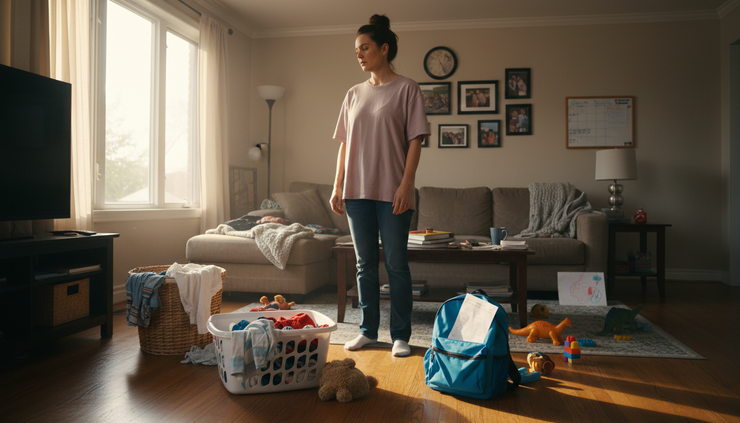
For many women, self-recognition begins only after burnout. They notice they are not just tired. They feel unable to start basic tasks. They are irritable, foggy, forgetful, or numb. They may feel ashamed because they love their family and still feel overwhelmed by the constant management of life.
That shame can soften when ADHD enters the picture. The question changes from “Why can’t I handle this?” to “What kind of support does my brain actually need?”
A child’s diagnosis often becomes a mirror
Many women first recognize ADHD after a child, partner, sibling, or parent receives a diagnosis. This is one of the most common paths to self-recognition.
A parent sits through a child’s evaluation and hears descriptions that feel uncomfortably familiar:
Difficulty starting homework
Big emotions that pass quickly
Losing belongings
Talking a lot or interrupting when excited
Hyperfocus on favorite activities
Trouble shifting from one task to another
Forgetting instructions despite good intentions
Meltdowns after holding it together all day
At first, she may think, “That sounds like every child.” Then the thought shifts: “That sounds like me.”
This can be powerful and disorienting. A mother helping her child with emotional regulation may realize she was never taught those skills herself. A woman reading about inattentive ADHD may remember childhood report cards that said “bright but careless” or “does not work to potential.” A partner’s diagnosis may explain household patterns that once caused conflict, then reveal her own parallel struggles.
Family diagnosis can also reduce stigma. When ADHD is understood as a brain-based condition rather than a character flaw, it becomes easier to revisit the past with compassion. The same traits that once felt like moral failures can be seen as signs that support was missing.
This does not mean every forgetful or overwhelmed parent has ADHD. Life is demanding, and many conditions can overlap. But when the pattern stretches back to childhood, appears across settings, and causes ongoing impairment, an evaluation may be worth considering.
The road to self-recognition is often emotional
Learning about ADHD later in life can feel like finding the missing chapter of a personal history. Events that once seemed random may start to connect.
There may be relief:
“I am not broken.”
There may be grief:
“Why did no one see this sooner?”
There may be anger:
“I was trying so hard, and people thought I did not care.”
There may be hope:
“Maybe I can stop forcing myself to function the hard way.”
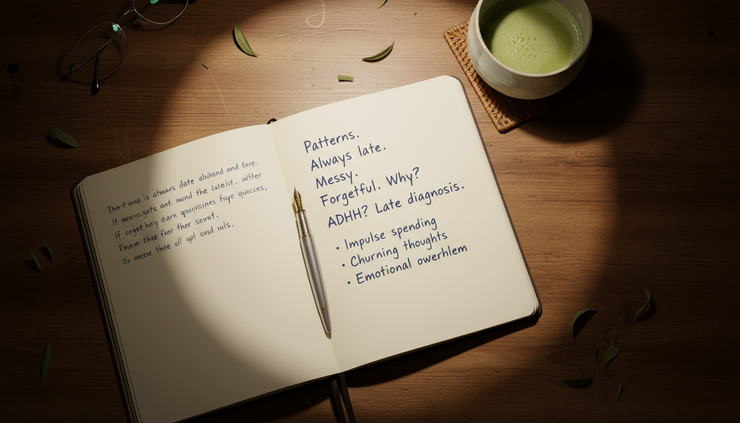
Self-recognition is not the same as self-diagnosis, but it can be the first step toward getting help. A formal evaluation may include personal history, symptom questionnaires, interviews, records from childhood when available, and screening for other conditions. For adults, especially women with years of coping strategies, it helps to work with a clinician who understands how ADHD can present beyond the most familiar stereotypes.
Support may include education, therapy, coaching, medication, environmental changes, relationship support, and practical systems. The right mix is personal. What matters is that support should reduce shame and make life more workable, not demand perfection under a new label.
What can help after recognition
A late ADHD diagnosis, or even a strong suspicion, can raise a practical question: what now?
Small changes can make a real difference. They work best when they reduce the need to remember, decide, or start from scratch.
Helpful supports may include:
Keeping essentials in visible, consistent places
Using fewer planning tools instead of many disconnected systems
Setting reminders for transitions, not only deadlines
Breaking tasks into the first visible action
Creating body-doubling routines, such as working near another person
Building recovery time after socially or mentally demanding events
Naming sensory needs around noise, clutter, clothing, or lighting
Asking for shared household responsibilities to be explicit
Treating rest as maintenance, not a reward for finishing everything
Self-compassion is not a decorative extra. It is part of treatment and daily functioning. Shame often makes ADHD symptoms worse because it adds fear and avoidance to tasks that are already hard. A kinder approach does not mean giving up responsibility. It means building systems around how the brain works instead of running life on self-criticism.
It can also help to revisit old labels. “Lazy” may have been task initiation trouble. “Careless” may have been working memory overload. “Too emotional” may have been nervous system intensity. “Not living up to potential” may have been unsupported ADHD.
Those reframes cannot change the past, but they can change the way a person carries it.
Hidden symptoms deserve real support
Late-diagnosed ADHD in women is often a story of effort that went unseen. Internalized symptoms stayed quiet. Masking made life look smoother than it felt. Perfectionism and anxiety kept things moving until they became too costly. Achievement brought praise while hiding the price. Caregiving turned attention outward. Then, sometimes through a child or family member’s diagnosis, the pattern finally came into focus.
Recognition does not erase the hard parts. It can still bring grief, adjustment, and difficult conversations. But it can also bring language, treatment options, better systems, and a more honest relationship with the self.
The most meaningful shift may be this: the question no longer has to be “What is wrong with me?” It can become “What support have I needed all along?”


Comments