


ADHD and Perimenopause How Hormonal Shifts Can Intensify Symptoms

A person who has managed ADHD for years can hit perimenopause and suddenly feel like all the old tools stopped working. The calendar reminders are still there. The medication may be the same. The coping skills have not vanished. Yet focus slips, moods swing faster, sleep gets lighter, and everyday tasks feel harder to start or finish.
That experience is not “just stress” or a personal failure. Hormonal changes during perimenopause can affect the same brain systems involved in attention, memory, emotional regulation, and motivation. For people with ADHD, that shift can make familiar symptoms sharper and less predictable.
This article is informational only and is not a substitute for medical care. If symptoms are interfering with daily life, a clinician who understands ADHD and menopause can help sort out options.

What perimenopause and menopause mean
Perimenopause is the transition leading up to menopause. During this time, the ovaries gradually produce less estrogen overall, but the change is not smooth or steady. Hormone levels can rise and fall in uneven patterns. Periods may become heavier, lighter, closer together, farther apart, or unpredictable.
Perimenopause often begins in the 40s, though it can start earlier for some people. It may last several years.
Menopause is defined after 12 months without a menstrual period, when no other medical cause explains the change. It marks the end of menstrual cycles. The years after that are often called postmenopause.
The key point is that many of the most noticeable symptoms happen during perimenopause, not only after periods stop. This is when hormone fluctuations can be most uneven, and for someone with ADHD, uneven can mean hard to plan around.
Common symptoms during perimenopause
Perimenopause can affect the body, brain, and mood. Not everyone has the same symptoms, and the intensity can change from month to month.
Common symptoms include:
Irregular periods
Heavier or lighter bleeding
Hot flashes
Night sweats
Sleep disruption
Brain fog
Forgetfulness
Irritability
Anxiety
Low mood
Headaches or migraines
Joint aches
Breast tenderness
Lower libido
Vaginal dryness
Changes in weight or body composition
More intense premenstrual symptoms
Some symptoms overlap with ADHD. For example, poor sleep can worsen attention. Anxiety can make it harder to start tasks. Brain fog can look like distractibility. That overlap can make it difficult to tell what is ADHD, what is perimenopause, and what is both.
For many people, the answer is both.
Why hormone shifts can intensify ADHD symptoms
ADHD is linked to differences in brain networks that support attention, impulse control, working memory, and emotional regulation. Dopamine and norepinephrine play important roles in those networks.
Estrogen and progesterone can interact with these systems. When hormone levels shift, the effects may show up in focus, memory, mood, and energy.
Estrogen and attention
Estrogen is thought to support dopamine activity in parts of the brain involved in executive function. Executive function includes planning, prioritizing, starting tasks, switching tasks, and holding information in mind long enough to use it.
When estrogen drops or fluctuates, some people notice:
More distractibility
Slower task initiation
Trouble finishing steps in order
More time blindness
More difficulty with decision-making
A stronger sense of mental static
Someone who once managed ADHD by using structure may find that the structure still helps, but not as much as before. The brain may need more external support than it used to.
Progesterone and mood
Progesterone also changes during perimenopause. It can affect sleep, calm, and emotional tone. Some people feel more relaxed at certain points in the cycle. Others feel more tired, flat, irritable, or foggy.
During perimenopause, progesterone may become less predictable as ovulation becomes less regular. That can contribute to mood shifts that seem to arrive without warning.
For ADHD, this matters because emotional regulation is already a core challenge for many people. A small frustration can feel much bigger when sleep is poor, estrogen has dipped, and progesterone patterns are changing.
Memory and brain fog
Working memory is the brain’s mental sticky note. It helps with things like remembering why you walked into a room, keeping track of a conversation, or holding three errands in mind while getting out the door.
Perimenopause can make working memory feel less reliable. For someone with ADHD, that can show up as:
Losing words mid-sentence
Forgetting appointments even with reminders
Reading the same paragraph repeatedly
Starting a task and drifting into another
Feeling embarrassed by mistakes that seem out of character
This can be especially upsetting for people who built an identity around being capable, organized, high-achieving, or “the one who holds everything together.”

What this can look like in real life
The connection between ADHD and perimenopause can be easier to understand through lived experience. The following examples are fictional composites based on common patterns. They do not describe any one person.
Maya notices her medication feels less consistent
Maya, 46, was diagnosed with ADHD in her 30s. For years, her treatment plan worked well. She used medication, a wall calendar, and strict morning routines.
Then her periods became irregular. Around the same time, she noticed that some weeks her medication seemed to work as expected. Other weeks, it felt like it barely touched her symptoms. She became more forgetful, missed a dentist appointment, and snapped at her teenager over a small mess in the kitchen.
At first, Maya blamed herself. She thought she had become lazy or careless. After tracking her symptoms, she saw a pattern. The worst focus and mood symptoms clustered around poor sleep, night sweats, and cycle changes.
That pattern gave her a starting point. Her clinician reviewed her ADHD treatment, sleep, and perimenopause symptoms together instead of treating them as separate problems.
Renee feels like her brain has “too many tabs open”
Renee, 51, had never been formally diagnosed with ADHD, but she had always struggled with procrastination and clutter. She coped by working under pressure and keeping a packed schedule.
During perimenopause, the system collapsed. She still got things done, but only after days of avoidance and panic. She forgot words, lost her keys several times a week, and felt overwhelmed by normal household decisions.
Renee described her brain as “too many tabs open, and all of them are playing sound.”
After an evaluation, she learned that lifelong ADHD traits had become more impairing during perimenopause. That explanation did not fix everything, but it reduced the shame. She began using shorter task lists, body doubling, and a sleep plan. She also talked with her clinician about treatment options for both ADHD and menopause symptoms.
A late diagnosis is common
Some people first recognize ADHD during perimenopause. The signs may have been there for years, but earlier life structures helped mask them. School deadlines, busy family routines, or high urgency may have provided enough external pressure to keep life moving.
When hormones shift, sleep changes, caregiving demands increase, or work becomes more complex, those old coping methods may stop being enough.
That does not mean the ADHD is new. It may mean the support needs have changed.
How ADHD and perimenopause can feed each other
ADHD and perimenopause can create a loop. One symptom worsens another, and the pattern becomes harder to break.
Perimenopause change | Possible ADHD impact | What it may feel like |
Poor sleep from night sweats | Weaker focus and impulse control | “I cannot think clearly today.” |
Estrogen fluctuations | Less consistent executive function | “My tools worked last month, but not now.” |
Mood shifts | Stronger rejection sensitivity or irritability | “Everything feels personal.” |
Brain fog | More working memory slips | “I forgot what I was doing again.” |
Heavier periods or fatigue | Lower energy for routines | “Even basic tasks feel too big.” |
This loop is not a character flaw. It is a signal that the brain and body need more support.
Practical strategies for managing ADHD during this transition
There is no single fix for ADHD symptoms during perimenopause. A layered approach often works best. The goal is to reduce friction, protect sleep, and make support easier to access on hard days.
Track symptoms without turning it into a project
A simple tracker can reveal patterns. Keep it brief so it does not become another abandoned system.
Track a few things daily or a few times per week:
Sleep quality
Period or spotting
Hot flashes or night sweats
Focus level
Mood
Medication timing, if relevant
Major stressors
Use a paper calendar, notes app, or printable chart. A pattern over several weeks can help a clinician make better recommendations.
Revisit ADHD treatment with a clinician
If ADHD medication feels less effective, do not assume nothing can be done. Hormone shifts, sleep disruption, new anxiety, and other health changes can all affect symptoms.
A prescriber may discuss:
Medication timing
Dose adjustments
Side effects
Sleep quality
Anxiety or depression symptoms
Blood pressure or other health factors
Whether another treatment approach makes sense
Do not change prescription medication without medical guidance.
Ask about menopause treatment options
For some people, treating perimenopause symptoms improves ADHD management because sleep, mood, and brain fog improve. Options vary based on health history and symptoms.
A clinician may discuss lifestyle changes, nonhormonal treatments, or hormone therapy. Hormone therapy is not right for everyone, but it can be helpful for some people with hot flashes, night sweats, vaginal symptoms, or other menopause-related concerns.
The best care looks at the whole picture, not just one symptom at a time.
Build a lower-demand version of your routines
Perimenopause can make energy less predictable. Instead of expecting the same output every day, design “minimum viable” routines.
For example:
On a high-energy day, cook a full meal.
On a low-energy day, eat eggs, toast, and fruit.
On a high-focus day, clean the bathroom.
On a low-focus day, wipe the sink and replace the towel.
On a steady day, sort all the mail.
On a foggy day, throw away obvious junk mail only.
This keeps life from becoming all-or-nothing.
Use external memory wherever possible
Do not rely on memory when memory is under strain. External systems are not a weakness. They are ramps for the brain.
Helpful supports include:
One visible calendar for the household
Phone alarms with clear labels
A medication organizer, if appropriate
A launch pad near the door for keys, wallet, glasses, and bags
Written instructions for repeated tasks
Automatic refills and bill pay when safe and practical
Checklists for mornings, evenings, and appointments
The best system is the one you can use when tired.
Protect sleep as a medical priority
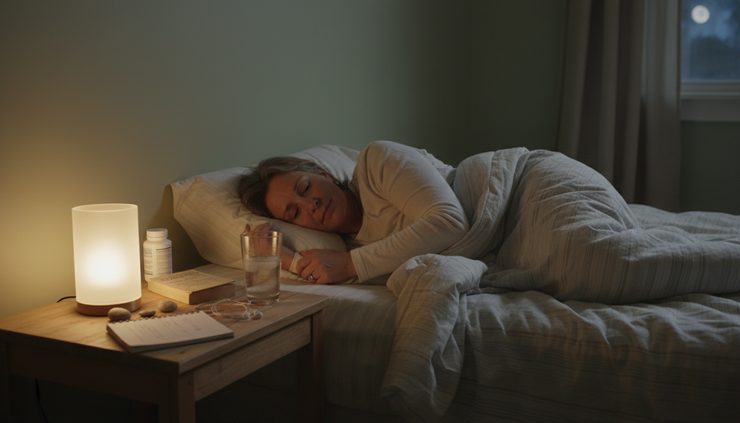
Sleep loss can intensify ADHD symptoms quickly. Perimenopause often brings night waking, night sweats, or early morning waking, so sleep may need more attention than before.
Possible supports include:
Keeping the bedroom cool
Wearing breathable sleepwear
Limiting alcohol, which can worsen hot flashes and sleep quality for some people
Keeping a consistent wake time
Treating snoring or possible sleep apnea
Talking with a clinician about night sweats or insomnia
If sleep has fallen apart, it deserves care. It is not just a lifestyle issue.
Reduce shame with better language
Many people describe themselves harshly when symptoms spike. They say they are lazy, scattered, bad with money, bad at relationships, or unreliable.
Try replacing judgment with a more accurate description:
Shame-based thought | More useful reframe |
“I am failing at everything.” | “My symptoms are under-supported right now.” |
“I should be able to handle this.” | “My brain is dealing with more load than usual.” |
“I am impossible to live with.” | “I need tools for mood and communication.” |
“I cannot trust myself.” | “I need reminders and backup systems.” |
Better language does not erase the problem, but it makes problem-solving easier.
Use body doubling and shared structure
Body doubling means doing a task while another person is present, either in person or virtually. The other person does not need to help. Their presence can make it easier to start and stay with the task.
This can help with:
Paying bills
Folding laundry
Meal prep
Decluttering
Exercise
Making appointments
For people with ADHD symptoms that worsen during perimenopause, shared structure can reduce the mental effort of getting started.
Plan for emotional surges before they happen
Mood changes can feel sudden, but planning helps. Create a short list of what to do when emotions spike.
A plan might include:
Pause before sending texts or emails
Drink water and eat something with protein
Step outside for five minutes
Use a phrase with loved ones such as “I need a reset before we continue”
Write the thought down instead of acting on it right away
Schedule hard conversations for times of day when focus is better
This is not about suppressing feelings. It is about giving the nervous system time to settle before choosing a response.

When to seek extra support
Reach out for professional help if symptoms interfere with work, relationships, parenting, finances, driving, sleep, or basic self-care. Support is also important if mood symptoms feel severe, if anxiety becomes hard to manage, or if there are thoughts of self-harm.
Good support may come from:
A primary care clinician
A gynecologist or menopause-informed clinician
A psychiatrist or psychiatric nurse practitioner
A therapist familiar with ADHD
An ADHD coach
A sleep specialist, when sleep problems are ongoing
Bring notes if possible. A brief record of cycle changes, sleep, mood, and attention can make appointments more productive.
The takeaway
ADHD and perimenopause can collide in a way that feels confusing and discouraging. Hormonal shifts can affect attention, memory, sleep, and mood, which are already sensitive areas for many people with ADHD.
The most useful response is not self-blame. It is curiosity, tracking, medical support, and practical systems that match the brain you have right now. Symptoms may be louder during this transition, but they are not beyond help. With the right support, this stage can become less chaotic and more understandable, one adjustment at a time.


Comments